
inSilico Dynamics · Computational biophysics
EGFR Resistance: MM-GBSA vs Docking (MD Case Study)
A comparison of osimertinib docking and end-point free-energy estimates across EGFR constructs, with unresolved comparisons and WT non-convergence reported alongside the results.
Question
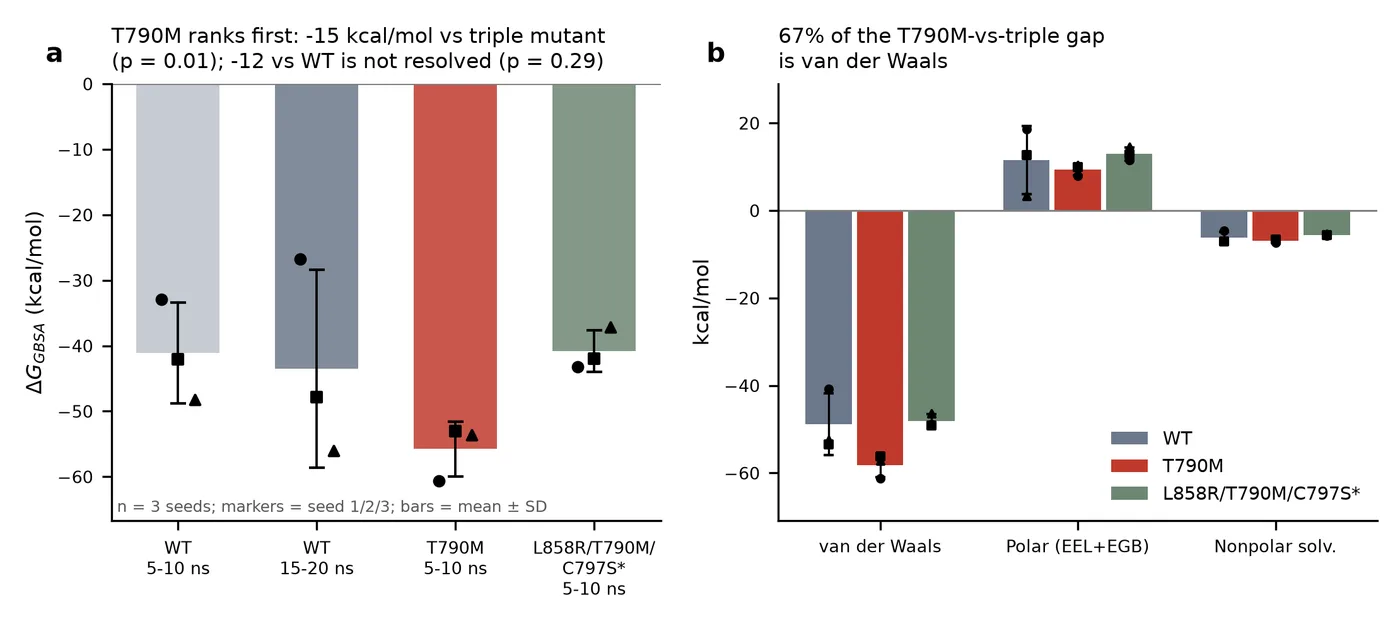
Does end-point MM-GBSA rank the EGFR resistance pattern for osimertinib better than docking scores? Both methods put T790M first. Only the T790M–triple-mutant comparison is statistically resolved; the WT comparisons are not resolved.
Systems and methods
Osimertinib was docked into WT (4WKQ), T790M (6JX0) and the L858R/T790M/C797S construct (6LUD). OpenMM simulations used ff14SB protein, GAFF2/AM1-BCC ligand parameters with a shared charge set, TIP3P water and 0.15 M NaCl.
Minimisation and NVT/NPT equilibration preceded 3 × 10 ns per genotype. The 3 seeds re-draw velocities from one equilibrated state per genotype; they are not independent starting structures. WT was extended by a further 10 ns per seed.
AmberTools MMPBSA.py used single-trajectory MM-GBSA, igb = 5 and 0.15 M salt, with 250 frames from the last 5 ns of the chosen window: WT 15–20 ns, T790M and triple 5–10 ns. All free energies use the common receptor range EGFR 701–989. There is no entropy term.
Docking and MM-GBSA results
| Genotype (start structure) | Docking, mean of 3 seeds | ΔG_GBSA, mean ± SD | MM-GBSA window |
|---|---|---|---|
| WT (4WKQ) | −7.87 | −43.5 ± 15.1 | 15–20 ns |
| T790M (6JX0) | −8.80 | −55.8 ± 4.2 | 5–10 ns |
| L858R/T790M/C797S* (6LUD) | −8.67 | −40.8 ± 3.2 | 5–10 ns |
* The 6LUD construct also carries E865A/E866A/K867A; differences from the other constructs cannot be attributed to L858R and C797S alone.
- Both methods rank T790M first. MM-GBSA resolves T790M from the triple-mutant construct: −15.0 kcal/mol (95% CI −23.8 … −6.3; Welch p = 0.01; n = 3 seeds per genotype). About two thirds of the gap (−10.1 kcal/mol) is van der Waals.
- T790M vs WT is not resolved: −12.2 kcal/mol (95% CI −46.6 … +22.1; p = 0.29).
- WT vs triple mutant is not resolved: −2.8 ± 8.9 SE kcal/mol. Docking ranks the triple mutant above WT; MM-GBSA cannot say.
- Welch tests and confidence intervals use seed means. No multiplicity correction was applied; the README notes that the T790M–triple p = 0.01 remains below 0.05 after Bonferroni correction.
Residue decomposition
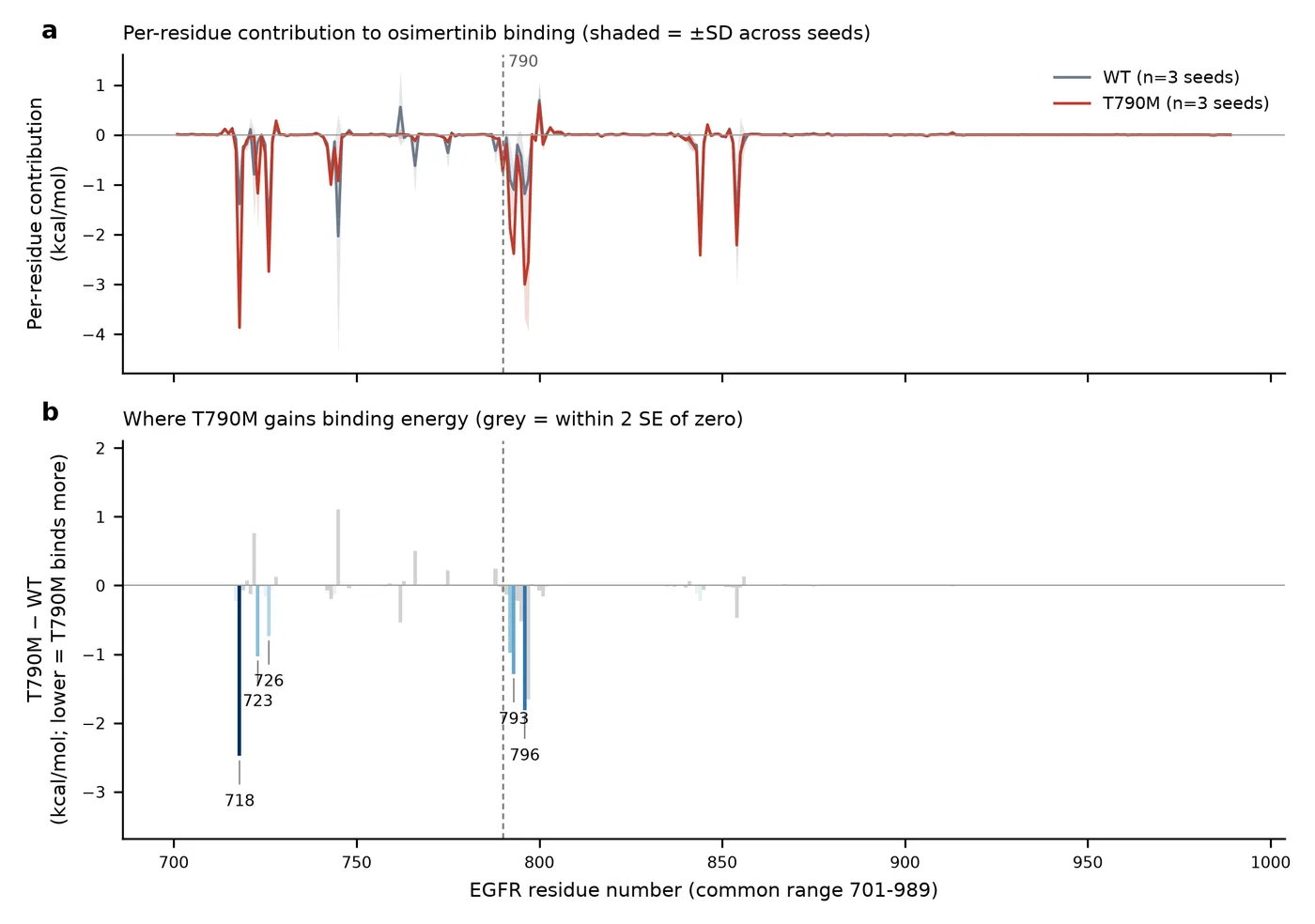
The decomposition uses 3 seeds per genotype and 25 frames per run. The reported T790M gain concentrates on residues 718 (−2.5 ± 0.5 SE kcal/mol), 796 (−1.8 ± 0.5), 793 (−1.3 ± 0.3), 792, 723 and 726. Residue 790 itself contributes −0.1 ± 0.3. Residue 797 (−1.66 ± 0.85) is not resolved.
RMSD, plateau and WT convergence
Core Cα RMSD uses residues 701–989. In the 5–10 ns window, both core and ligand plateau for all T790M and triple-mutant seeds. In WT, osimertinib moves away from the docked starting pose in all three seeds. At 15–20 ns, WT seed 1 reaches ligand RMSD 5.6 Å; seed 3 is still drifting at +0.22 Å/ns.
WT is not converged. Its ΔG reflects different poses across seeds (−27 to −56 kcal/mol), rather than a settled comparison of the same pose.
Interpretation and limitations
This is a computational study, not experimental validation. Absolute ΔG values are model-dependent; only ranking is interpretable within these limitations.
- Starting-structure bias. WT starts from a gefitinib-bound crystal; the mutant structures contain the co-crystal ligand YY3. Osimertinib was docked into each. Pocket shapes differ by construction and may favour the mutants, contributing to WT pose drift.
- Seeds share one equilibrated state. n = 3 per genotype underestimates structural uncertainty; the T790M–WT comparison is under-powered.
- WT not converged at 20 ns. Seed 3 still drifts and seed 1 settles in a displaced pose. Longer WT runs from several starting poses remain an open item.
- Covalent binding is not modelled. Osimertinib binds C797 covalently; these calculations are non-covalent, so C797S resistance is not expected to appear in these energies.
- No entropy; GB/PB disagreement. The same T790M seed frames give ΔG_GB = −60.7 and ΔG_PB = +0.8 ± 0.3 (SEM) kcal/mol. The roughly 60 kcal/mol difference limits interpretation of absolute values.
- Residue decomposition is limited. Only 25 frames per run and three seeds are used. An earlier single-seed comparison against unequilibrated WT suggested residue 797 as the largest contributor (−3.4); with three seeds it is −1.66 ± 0.85 and not resolved, while residue 718 leads.
Source and reproducibility
This page summarizes the public repository README. Read the methods, derived data and limitations in the source repository.